Now that we’ve finished the book officially, I have many mixed emotions. For one, I think Walton is a great example of how Victor should’ve conducted his life. He was compassionate, determined, and most of all, showed great levels of empathy. He was able to see through Victor’s hardships and mistakes in order to befriend him. That takes a lot of courage.
Another part of the book was the way in which Victor responded to the men’s uncertainty when moving forward. It was ironic how he spoke life and courage into them, even though he lacked it himself. It’s very unfortunate, but it showed Victor’s character.
Lastly, the Creature. I don’t think we can justify the killings of Victor’s family, but we can surely understand why he did what he did. If only he was shown true love, none of this would’ve happened. Overall, I think it was a great story with many underlying and meaningful concepts.
Growing up, I was always told to stay away from Wikipedia. It was unreliable, fictional, and anyone could add their own personal experiences, true or false. It wasn’t until my Freshman year of college in College Composition II that I was told I needed to use it. However, we were not allowed to use it as a source. Instead, we could only use Wikipedia to find connections between different words and phrases. For example, we would take a person or place, like Brazil, and somehow try and relate it to another word, like a popsicle. We would do this just by using the small links within the bigger articles.
I think when Wikipedia is used properly, it can be an excellent source. Not just for finding connections between things we typically wouldn’t think of, but for finding credible information. Because I was taught to not use Wikipedia, I have never taken the time to truly explore the different sources the encyclopedia has. But, I know that it’s still a great place to look at when trying to learn new information.
There is a downside to Wikipedia, however. Being able to add different information can be tricky because the information being added may not be true. We saw the example of a Wikipedia user adding harmful information about the assassination of former President John F. Kennedy. Though that situation was pretty extreme, I think it shows how dangerous editing can become. Overall, I would still view Wikipedia as a pretty credible source, when fact-checked.
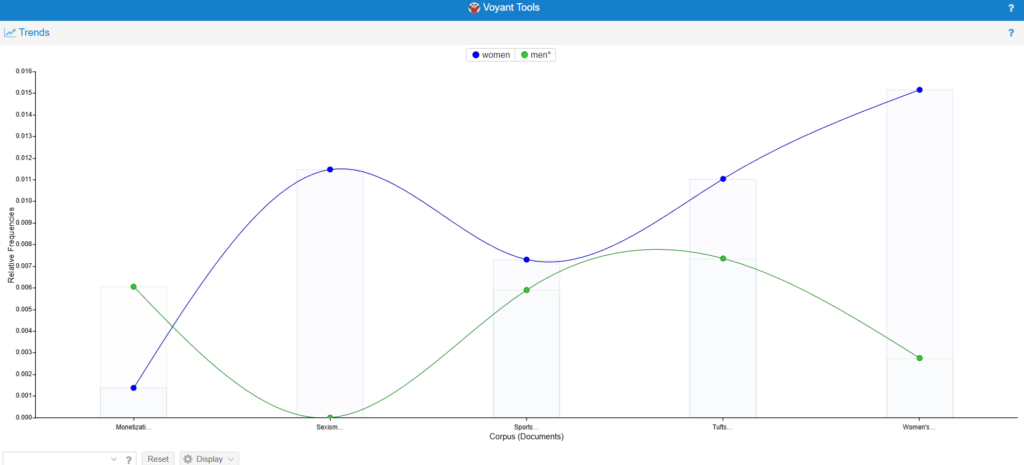
For my project, I wanted to focus on the growth of Women’s sports. However, while pulling my articles, I found some other relevant topics within the discussion of Women’s sports. I decided to break down each article into smaller sections and find the commons trends in each section. My overall goal was to figure out how people talk about Women’s sports, as well as how we describe where the hype around Women’s sports is going.
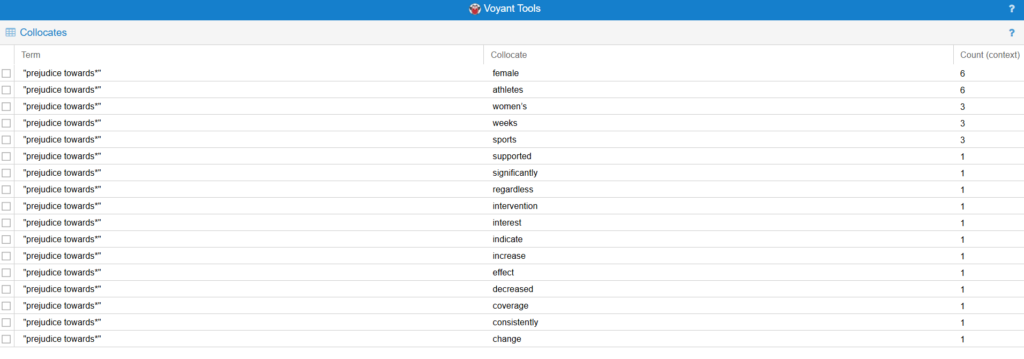
One interesting trend I saw was the use of the words, “Prejudice,” and “Towards.” More specifically, I saw a few collocates that reflected the phrase, “Prejudice Towards” women, athletes, and females. I found this interesting because the use of language here clearly indicates that there are some issues in Women’s sports, such as prejudice.
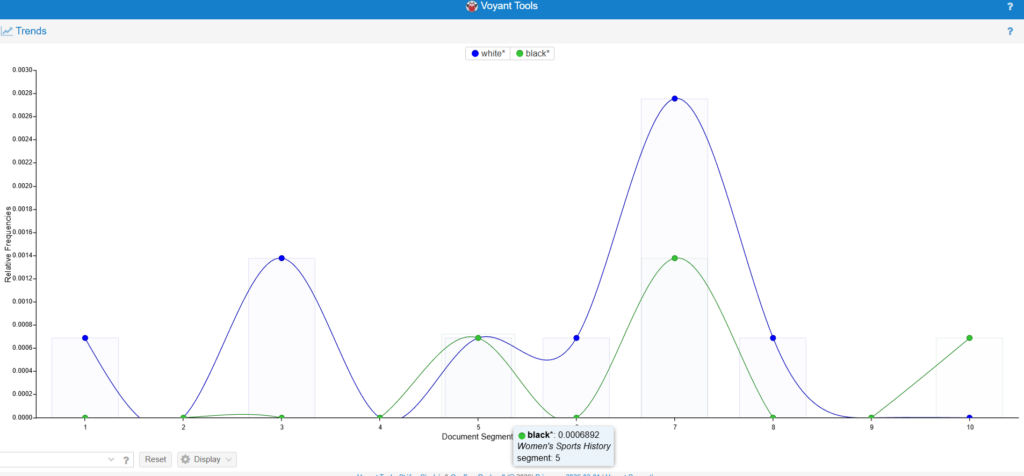
Another trend that I found was the use of “Black” and “White.” Though there isn’t a clear depiction of the race discussed, the word “White” appeared 10 times, while “Black” only appeared 4 times. To me, this shows a clear lack of diversity when talking about the growth of women’s sports. In Women’s Sports, there isn’t much discussion around other races of Women who have influenced the sport.
When it comes to women’s sports, I found that even though there are some positive areas in the growth, there also seems to be some issues within the system. There are levels of racism and prejudice towards female athletes that must be addressed. In order to address these issues, I think it’s important to find these trends within the way we talk about women’s sports.
As we’ve been reading more into Frankenstein, I am beginning to see the relationship between humanity and Gen-AI. At first, I wasn’t sure I was going to be able to see the connection, but I feel like we as a society are slowly finding ourselves playing into the role of Victor.
In my opinion, Gen-AI can be used for great things, but it should have boundaries. Just like Frankenstein, Victor was so focused on advancing his studies that he was unaware of what he was actually creating. I feel like the creators of these various AI systems feel the same way. They were unaware of how far their projects could go. Now, we all see how AI is influencing every part of our lives.
It’s scary to because I feel like everyone is talking about how much AI will progress, but no one seems to put in place any boundaries. I wonder, how much farther AI will go? Similar to the Creature, who will actually have power over AI? And how will we know that those who could “take control” will use AI smartly?
For this project, I am leaning towards a few different topics to focus on. My first option would be to focus on Women’s Sports, specifically the evolution of it. I feel like this would be a good way for me to gain a lot of information through distant reading. Another option I have been thinking about pursuing is doing something in the field of music, but I think I will keep using what I have, which is the evolution of Women’s Sports.
I have been able to find some empirical research papers and articles that talk about my topic. I am still currently looking for readings that share larger bodies of text. I used traditional searching methods like Google in order to find what I was looking for. One article in particular listed a timeline that shows the most influential events in Women’s sports, dating back to 1896. Another article that I found interesting was one that reflected the negatives of the growth in Women’s Sports. I think that being able to compare and contrast the way different medias are presented will show the underlying trends within distant readings.
Personally, I am really interested in sports and Sport Psychology, so I think a great way for me to learn more about this topic is to use it for my distant reading. I am aware of how Women’s Sports have evolved over the years, but I do not know the exact way it has evolved and the patterns and trends that have been hidden overtime, but I am very excited to learn more about my topic!
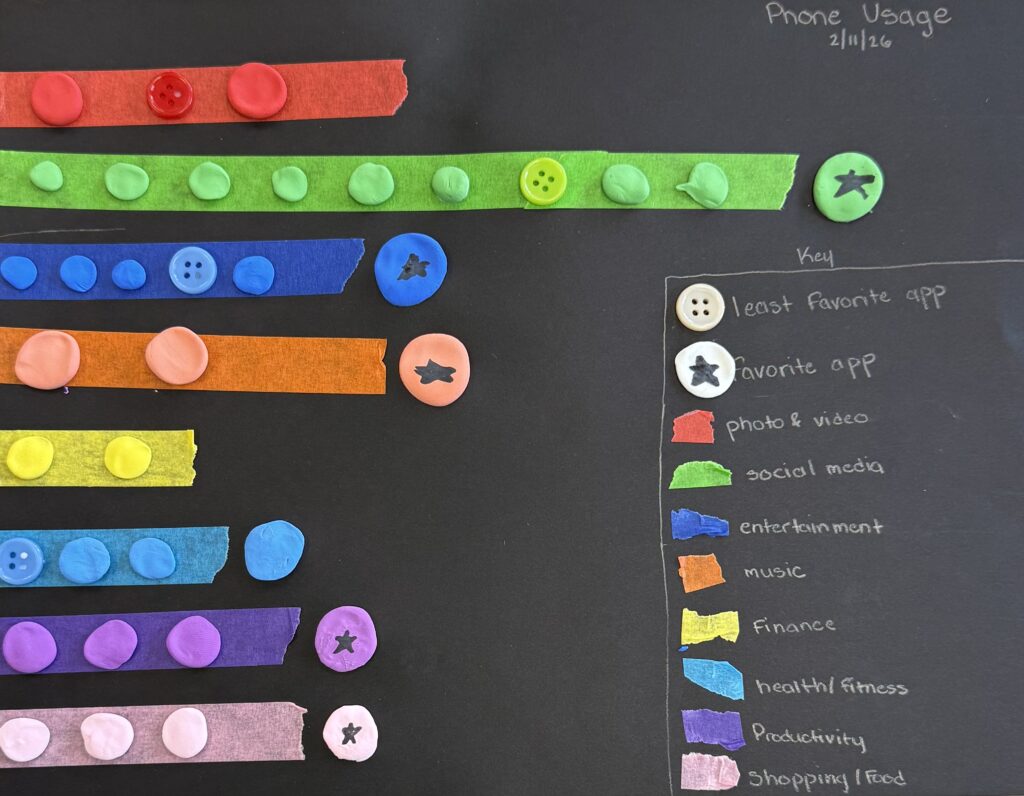
For my Dear Data Project, I decided to collect data about my phone usage and my complaints. At the beginning, I was very unsure about what I would come up with, especially when it came to how I was going to bring my data visualization to life. However, I am very proud of my full project and learned a lot about myself in the process.
For my short-term data visualization project, I decided to record my phone usage. Before I began this part of my project, I assumed that I spent a good amount of my phone time on productivity apps. It wasn’t until I completed my data collection that I realized I spend most of my time on social media apps. The most difficult part of this assignment was seeing how much time I was seemingly wasting on my phone. I typically try to spend most of my days doing things that do not require the use of my phone, but this project made me realize that I actually use my phone more than I previously thought I did. However, because this part of my overall project focused on short-term data collection, I would say that the easiest part was analyzing what I did on my phone for only a small period of time. In order to track my data, I used my rough-draft, along with my phone to check the apps I use.
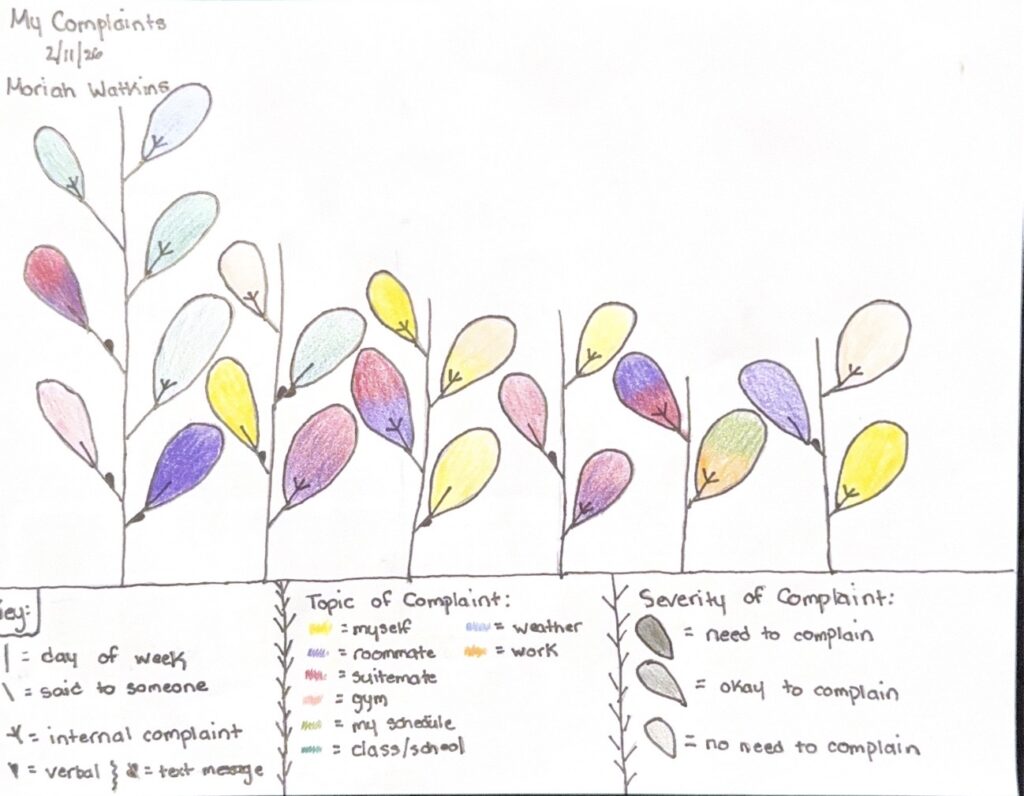
The long-term part of my project was focused on my complaints. Similar to how I felt before I started collecting data for my phone usage, I didn’t think my list of complaints for the week would be very long. It was to my surprise that I did in fact complain more than I initially realized. To start this process, I used the Notes app on my phone to log all of my complaints for the week. One interesting thing I noticed during this part was that many of the complaints I made were about the same thing. Another area that I thought was interesting was the difference between the internal and external complaints I was making. Even though it was hard to see my complaints written down in front of me, I was also happy that I chose to collect data on my complaints because I can now identify the patterns within my complaints. To be transparent, there wasn’t anything I would consider to be “easy” with this assignment. Logging my complaints was already tough enough, so it made things even more challenging when I had to find a way to visualize them. Luckily, I was able to find a way that I felt best expressed my data and made it easier to understand to other viewers.
Overall, this was a project that I never saw myself doing, but I am glad I had to. Not only did I learn about myself, but I also learned how anything can be turned into data. The smallest areas of our daily lives can somehow be turned into a data visualization project.
For my project, I decided to track how much I complain for my long-term data and my phone usage/apps for my short-term data.
Now that I’m finished gathering my data, I am interested to see how I will be able to bring my data to life. I have some ideas for how I want to portray what I’ve learned about myself. For my short-term data, I want to create a GPS for my phone. It will show how I “travel” throughout my phone, which I think will be a cool way to visualize what I’ve gathered!
Now for my long-term data, I’m stuck between two ideas. For one, I want to make this part of my project 3D. With this being said, I’m thinking about creating an image of myself carrying a “bag,” filled with my complaints. Another way I was thinking about visualizing my data is by creating an image of my heart or mind, to show how I feel about each complaint and what they are tied to. For both visions, I am not entirely sure how I will execute this, but I feel like it will be a creative way of seeing my personalized data.
The easiest part about this project is interpreting my data. I can easily identify my own habits and tendencies throughout the week because I understand myself and what I like and do not like, which contributes to my complaints. The hardest part is trying to display this same level of understanding in others. I want a viewer to understand the same patterns I see within myself through my visuals.
I’m not completely sure what route I will take, but I’m excited to see how this project will turn out!
For my Dear Data Project, I decided to pick how much I complain, along with my phone activity. For this post, I want to talk about my complaining habits.
Before I started, I told my parents about this project. When I told them about what I picked (my complaints), they said: “Well, you don’t really complain that much.” I agreed in the moment, but now that the week of logging all of my complaints coming to a close, I’m not so sure about that! However, I really enjoy this project. When I think of data, I typically think of experiments that have been constructed long ago. However, to be the “person of interest” in this amazing to me. I love studying behaviors, so it’s pretty cool to be the participant of my own, “study.”
Another part of this project that I really enjoy is coming up with new ways to show your data. I don’t have to use SPSS to categorize my own observations, which is refreshing!
Hi everyone! My name is Moriah Watkins. I am a second-year Psychology student, minoring in the Psychology of Sport and Exercise Science. My goal is to become a Clinical Sports Psychologist, giving me the chance to work with athletes who are going through things that their fans, spectators, coaches, and peers may not see. Truthfully, I have a strong desire to get athletes to understand that they are more than the number they wear or their statistics from their best and worst games. Besides learning about things related to my education, I also really enjoy music, playing and watching sports, and reading:)
When it comes to Digital Humanities, I honestly don’t know where to start. From what I’ve learned so far, it’s hard to put Digital Humanities in a box, because it can become so complex. However, I want to finish this course knowing how I can use Digital Humanities to expand how I learn, how I study what’s around me, and how I view myself. I never took a second to think about how impactful Digital humanities can be. But with what I am learning now, I think practicing effective Digital Humanities can help me analyze and make sense of data, especially in the world of Sports Psychology…and even in my own little world.